
Heathland Bird Surveys 2025
Across the summer last year the whole Hepple Wilds squad, and some of our mighty volunteers, participated in the British Trust for Ornithology’s (BTO’s) Heathland Bird Survey. This meant a lot of crepuscular survey work for nightjar, the only one of the main target species found in our area (the others being woodlark and Dartford warbler). The survey was designed to update important records for these species, with the last nightjar population being estimated in 2004 (4,600 territories or churring males). The survey targeted areas of known distribution, as well as areas of possible expansion. While we have anecdotal records of nightjar on and near site in recent years, we have not picked them up or recorded territories through formal survey so this was an exciting prospect for us.
Nightjars (specifically the European nightjar Caprimulgus europaeus) are a truly fascinating species. They are a summer migrant that arrive in the UK fairly late, usually by mid-May, arriving from their winter holidays in sub-Saharan Africa. Needing bare ground, but also sparse scrub or woodland for foraging, they have a strong preference for diverse heathlands and woodland clearings. Recently-felled conifer plantations provide a good (though relatively artificial) habitat but these are short lived due to the common practise of replanting and the rapid growth of conifers. Open moorlands such as those historically found in and around Hepple, primarily managed for red grouse, provide a poorer habitat for nightjar, due to the lack of food sources. With areas of our moorland slowly regenerating with young birches, oaks, rowans and pine, it was with great optimism that we began our survey work. Areas of felled, storm-Arwen-smashed and regenerating plantations, both on-site and adjacent to us, also gave us hopes of incoming migrants.
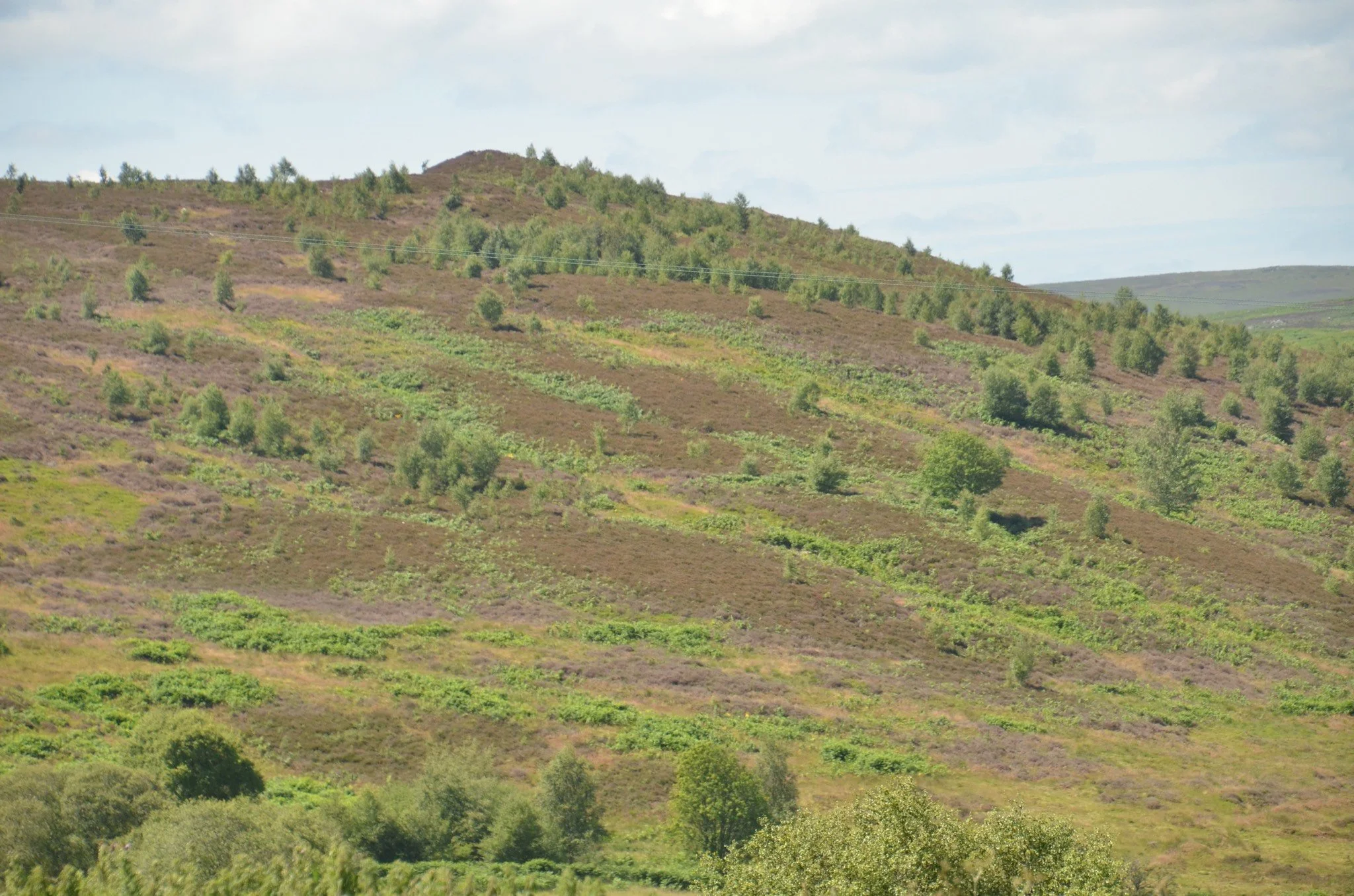
Bird woodland regenerating on site to create a more diverse habitat © The Hepple Estate
Surveys were conducted between the 20th of May and the 31st of July, with 15 evenings of survey work completed by our team of surveyors. Due to the sheer amount of suitable habitat on site, the site was broken up in 21 grid squares and each square was to be surveyed twice; once early in the season (late May & June) and once later (July). Surveys were conducted as close to the BTO standards as possible however we did agree with the BTO for a slightly different approach, due to the large scale of the site and survey area. During each survey, grid squares were covered through a mix of walking and standing at key vantage points, always looking and listening for signs of our quarry. The most identifiable sign of nightjar is the song of the male bird – or its churring. The birds sing around sunset and sunrise and otherwise remain hidden amongst the heath and leaves, perfectly camoflauged. Their unique call is an undulating sound that can continue at the same pitch for minutes at a time and, on a still night, can carry for many hundreds of meters. Because of this, as long as the weather was calm, we were able to survey large areas of the more open ground from high vantage points, listening for the eerie call across the moors. In some cases we were aided with a parabolic microphone.
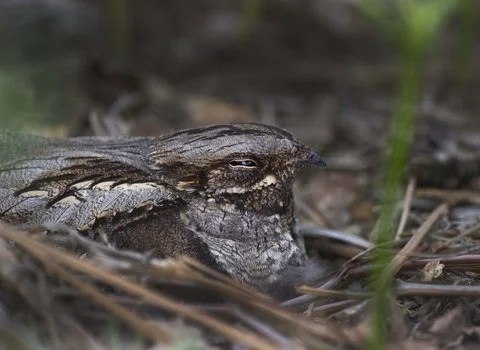
European nightjar © David Tipling - The Wildlife Trusts
Across the surveys at least 25 churring males were recorded on site or within 500m, where accessible. Nine of these males were recorded in the same locations in both of the survey visits. While not wholly accurate, males holding territory across two surveys could be seen as a successful breeding territory. While birds being recorded on only one visit cannot guarantee breeding, it indicates high quality habitat nonetheless.
Eight of the singing males, and four of the potentially successful breeding territories, were recorded within the Hepple Estate. Of those eight, seven (including all four held territories) were recorded within our regenerating birch woodland while only one was heard within our Arwen-hit plantations. This last result is most exciting as it indicates that our young birch woodland, of which there will be a lot more to come, is regarded as a high-quality habitat for the birds, perhaps even in preference to the plantations. Of the 8 birds on site therefore, we recorded 50% of the birds holding territory across both survey periods. In the areas surveyed adjacent to site (all primarily spruce plantation), this figure was 29.4%.
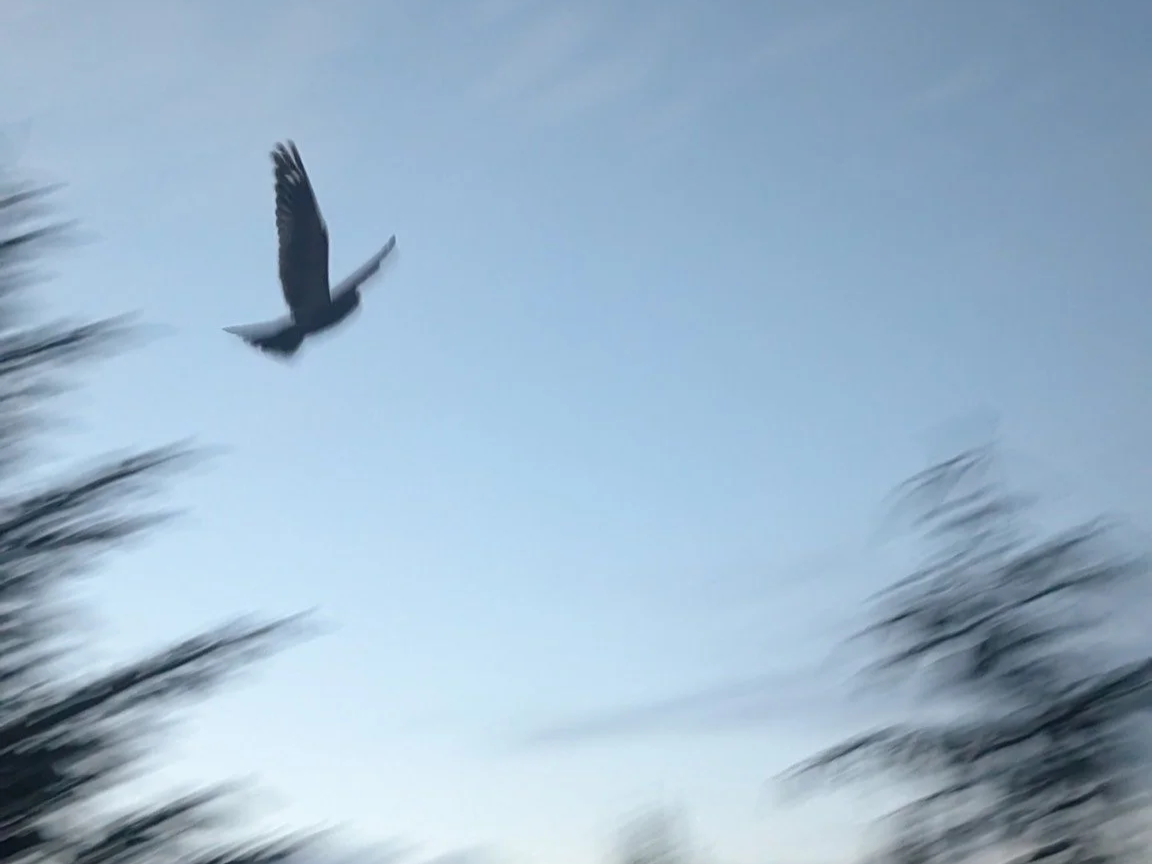
Male nightjar in flight, recorded during surveys on site © The Hepple Estate
Other birds recorded during the survey work included whinchat, curlew, common snipe, woodcock, linnet and, a first for the site; a brood of long-eared owls within some of riparian birch woodland on the moor.
Analysis of the results from our site, and the national project, are still to be processed and reported on by the BTO but we believe that our results indicate a much higher population of nightjar in the area than previously understood, and hopefully a population still expanding. As the Hepple Wilds project goes forward we will certainly be increasing the amount of habitat for nightjars on site, and we look forward to seeing more of these special birds.
